
Three · Six · Nine
The 369 method,
said out loud
Three repetitions in the morning, six at midday, nine at night. It is the most practised manifestation technique there is — and almost every app that supports it gives you a text box. Shyne lets you speak it, listens for each repetition, and keeps the recordings on your phone.
The short answer
What is the 369 method?
The 369 method is a manifestation practice in which you repeat one intention three times in the morning, six times at midday and nine times at night, every day. It borrows its numbers from Nikola Tesla’s well-known fascination with three, six and nine, and it spread as a journalling technique — three lines, six lines, nine lines.
What actually makes it work has nothing to do with numerology. Eighteen deliberate repetitions a day, at three separated moments, is a rehearsal schedule. You are not informing the universe. You are changing what your own attention treats as normal — and attention is what decides which opportunities you notice and which you walk past. It is the same mechanism behind daily affirmations, which is where most people meet this idea first.
If you want the method on its own terms — guides on what to write, the 33-day cycle, a printable tracker and the questions people ask most — we keep a whole site for it at 369methodapp.com. This page is about practising it out loud.
Which is why the second half matters as much as the repetition itself: if you never record what arrives, the practice stays a wish. Shyne pairs 369 with a signs log for exactly this reason.
How to practise it
Three moments, every day
- 3Morning
Three times, before the day has an opinion
The first repetition of the day sets the frame everything else is read through. Write or speak your intention three times, in present tense, as a thing that is already true. Not “I want”, but “I am”.
- 6Midday
Six times, in the middle of real life
This is the repetition that does the work, because it lands while you are busy, distracted and slightly unconvinced. Six is enough to interrupt the day and short enough that you will actually do it.
- 9Night
Nine times, as the last thing
The final nine repetitions go in just before sleep, when the mind is least defended. Say it slowly. In Shyne, you can then listen back to your own voice saying it — which is a stranger and more convincing thing than reading it.
What Shyne adds
Saying it is not the same
as writing it
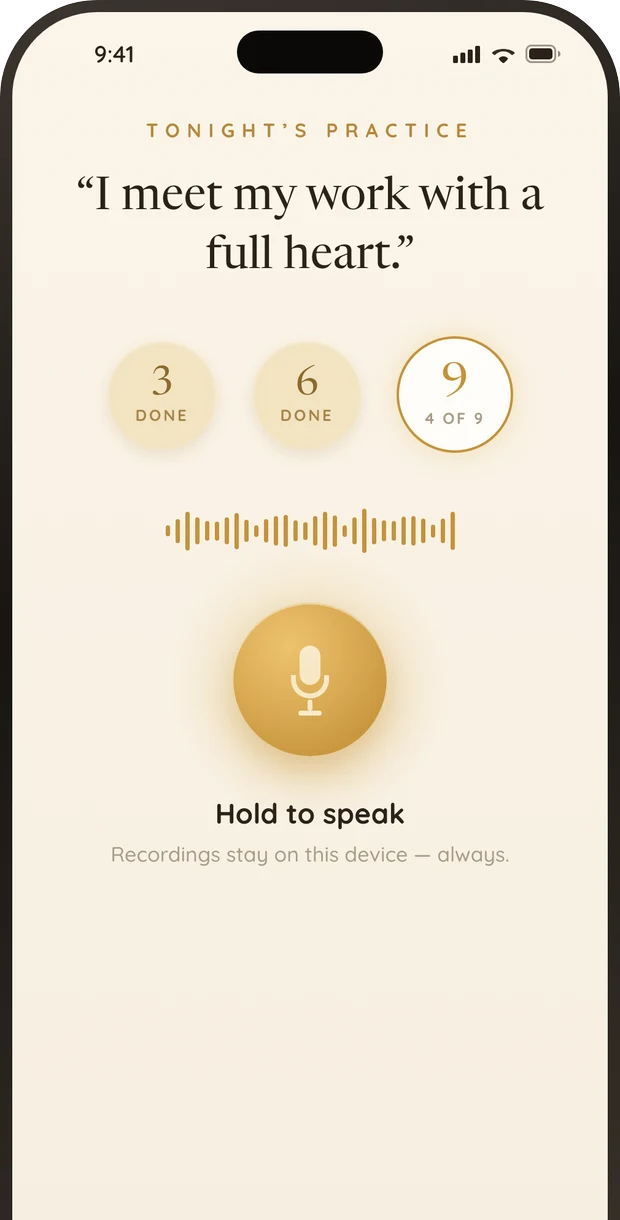
Writing can be done while thinking about something else. Speaking cannot. Shyne’s 369 practice is hold-to-speak: the app listens for your intention, counts the repetition only when it actually hears it, and unlocks stages three, six and nine in sequence.
It listens, honestly
On-device speech recognition matches what you said against your intention. A mumbled half-repetition does not count, because the point is the repetition, not the tally.
Hear yourself believing it
Every matched repetition is recorded and kept for the day, so you can play back your own voice. It is the most persuasive audio you will ever listen to — and it never leaves your iPhone.
Or write it, beautifully
Prefer the original? Written mode gives you the lines, an ink picker in the six practice tones, and a small pen nib that trails the last letter you typed.
Where people go wrong
Four things that quietly break it
- Writing it in the future tense
- “I will find work I love” keeps the thing permanently one step away. Present tense — “I am building a life that feels like mine” — is not wishful thinking; it is the whole mechanism.
- Changing the sentence every day
- Eighteen repetitions of a moving target is eighteen repetitions of nothing. Keep one intention in focus long enough for it to become familiar. Shyne enforces this: one intention is held on Home, and the rest wait.
- Treating a missed day as a failure
- Streak-driven apps turn one quiet day into a reason to quit entirely. Shyne records a missed day as an empty square and says nothing about it.
- Never logging what arrives
- Without evidence, the practice runs on willpower alone, and willpower runs out. Log the signs as they come and belief stops being something you have to manufacture each morning.
Shyne is a journalling and reflection practice. It is not medical, psychological or financial advice, and it does not claim any outcome.