
A daily practice
Daily affirmations,
without the wishful thinking
An affirmation is a sentence you say about yourself, on purpose, in the present tense. That’s the whole mechanism. What makes it work — when it works — is not that the universe is listening. It’s that you are.
This is everything worth knowing: what the research actually found, how to write one that doesn’t feel like a lie, and over a hundred affirmations you can start with tonight.
Today’s affirmation
I am on my own side, even now.
New one tomorrow. If you’d rather it arrived on your home screen than on a webpage, that’s what Shyne does.
The short answer
What a positive affirmation actually is
A positive affirmation is a short, present-tense statement about yourself that you repeat deliberately — usually daily, usually out loud or in writing.
Three things separate an affirmation from a nice thought:
- It's present tense.
- “I am steady under pressure,” not “I will be steady under pressure.” Future tense keeps the thing permanently one step ahead of you.
- It's about you.
- “I handle hard conversations well” — not “people respect me.” You can only affirm what's yours.
- It's repeated.
- One affirmation is a sentence. The same affirmation, every morning for a month, is a practice. The repetition is not decoration; it's the entire active ingredient.
People also call these self-affirmations, I am statements, or daily affirmations. Same thing.
The honest answer
Do affirmations actually work?
Sometimes. Not always. And there’s a specific case where they make things worse — which almost nobody selling affirmations will tell you.
What the research supports. Self-affirmation theory, developed by the psychologist Claude Steele in the 1980s, has a reasonable evidence base — but it’s about something narrower than most people assume. It looks at what happens when you reflect on your core values before facing something threatening: a difficult conversation, a health warning, a test. The finding is that people who do this tend to get less defensive and cope better. It’s about buffering threat, not about summoning outcomes.
Where it breaks down. In 2009, Wood, Perunovic and Lee published a study that has been quietly inconvenient for the affirmations industry ever since. People with low self-esteem who repeated “I am a lovable person” felt worse afterwards than those who said nothing.
The explanation is intuitive once you hear it. If a statement is too far from what you currently believe, saying it doesn’t install a new belief — it triggers the counter-argument. You say “I am confident,” and the part of you keeping score immediately produces the evidence file. Now you’ve rehearsed the evidence file.
What this means for you. Affirm something you can almost believe. The affirmation that works sits just outside your current position, not in a different postcode from it.
Not this
I am a millionaire.
This
I am someone who takes money seriously, and it shows.
The second one is arguable. Arguable is the target.
What affirmations are not. They are not a treatment for depression, anxiety, or trauma, and they are not a substitute for therapy. Cognitive behavioural therapy does something structurally different — it examines a belief and tests it against evidence. An affirmation asserts one. Those are not the same tool, and if you’re struggling, the assertion is the weaker of the two. Please talk to someone qualified.
Getting it right
Five rules for writing one that lands
Present tense, always.
“I am building something that's mine.” Not “I will build.”
Positive framing.
Say what you're moving toward, not what you're leaving. “I eat in a way that respects my body,” not “I don't binge.” The negated version makes you picture the thing you're negating.
Believable, not aspirational.
See above. If it makes you flinch, it's too far. Dial it back until it's merely uncomfortable.
Specific beats grand.
“I speak clearly in meetings, even when I'm nervous” outperforms “I am confident” — because you'll know whether it's true by Thursday.
Keep it short.
If you can't say it in one breath, you won't say it every day. Most of the best affirmations are seven to twelve words.
And one thing to avoid: changing it constantly. Thirty days of one affirmation does more than thirty different affirmations. Pick one. Let it get boring. Boring is the sound of something becoming normal.
When to say them
The daily part is the whole thing
Morning is the common recommendation and there’s a decent argument for it: the first thing you say about yourself sets the frame the rest of the day gets read through. Before email. Before the phone.
Night has its own case. The mind is least defended just before sleep, and evening repetition tends to be less performative — you’re not saying it to launch a day, just saying it.
Either works. Both is better than neither. Neither is what actually happens when you don’t pick a time.
Attach it to something you already do without deciding to — the kettle, the walk to the station, the moment before you unlock your phone. Practices survive by attaching themselves to habits, not by being remembered.
How many times? Somewhere between three and ten is plenty. The number is not magic. If you want the number to be structured, the 369 method gives you a schedule — three in the morning, six at midday, nine at night — and the schedule is the useful part, not the digits.
How long until anything happens? Give it thirty days before you judge it. Not because thirty is a threshold, but because it takes about that long to stop hearing your own sentence as a sentence.
A week of them
If you want the day to give you the theme:
- Monday
- I begin things well. Starting is not the hard part.
- Tuesday
- I do the work in front of me without borrowing tomorrow's.
- Wednesday
- I am steady in the middle of things.
- Thursday
- What I've built this week already counts.
- Friday
- I finish, and then I stop.
- Saturday
- Rest is not something I have to earn.
- Sunday
- I meet the week ahead already on my own side.
Somewhere to start
Over 100 affirmations, by what you need
Take one, not ten. The one you keep is worth more than the list you saved.
For confidence and self-worth
- I am allowed to take up the room I'm in.
- I speak clearly, even when my voice shakes.
- I don't need to be certain to begin.
- My worth is not a performance review.
- I am learning to be on my own side.
- I can be nervous and capable at the same time.
- I trust myself to handle what I don't yet know.
- I don't apologise for existing in a room.
- What I bring is enough to start with.
- I am becoming someone I'd have admired.
For self-love
- I speak to myself the way I'd speak to someone I love.
- I am allowed to be a work in progress.
- My body carries me. That earns it kindness.
- I don't have to fix myself before I'm allowed to rest.
- I forgive myself faster than I used to.
- I am not behind. There is no schedule.
- I like my own company.
- I can hold a flaw without it becoming a verdict.
- I am worth the effort I keep spending on other people.
- I am kind to the version of me who didn't know yet.
Some people search for “words of affirmation for self” — this is that. The love-language sense of the phrase is about what you say to a partner; this list is what you say to you.
For anxiety and hard days
- This feeling is loud, and it is not permanent.
- I can be afraid and still do the next small thing.
- My thoughts are not instructions.
- I have survived every day so far.
- I am allowed to slow down without falling behind.
- I don't have to solve it tonight.
- My breath is something I can always come back to.
- I can let this be difficult without it being dangerous.
- I am safe in this room, right now.
- I have got through worse with less.
If anxiety is affecting your daily life, please talk to a doctor or therapist. These are for steadying a hard morning, not for treating a condition.
For money and abundance
- I am someone who takes money seriously, and it shows.
- I make decisions from choice, not from panic.
- Money is a tool I'm learning to use well.
- I can receive without flinching.
- I am building something that pays me back.
- I keep what I earn on purpose.
- There is enough, and I am allowed a share of it.
- I am becoming someone money is comfortable around.
- I ask for what my work is worth.
- My worth and my balance are different numbers.
For work and career
- I do good work, and I let it be seen.
- I ask the question rather than guess.
- I am allowed to be new at this.
- I handle hard conversations without dreading them for a week first.
- My work is valuable when it is finished, not when it is perfect.
- I say no to protect the yeses that matter.
- I belong in the rooms I'm invited into.
- I take the credit that is mine.
- I am building a career, not surviving a job.
- I leave work at work.
For women
- I am not too much. I have simply never been small.
- I take up the space I've earned.
- My softness and my spine are not in conflict.
- I do not shrink to make a room comfortable.
- I trust the instinct I've spent years talking myself out of.
- I am allowed to want more than what's expected.
- I rest without justifying it.
- I am not responsible for managing everyone's feelings.
- My age is a record of things I survived.
- I choose myself, and it is not a betrayal.
For men
- I can be strong and still ask for help.
- I say what I mean before it becomes resentment.
- My worth is not my output.
- I let people see the version of me that isn't sorted.
- I am steady, and steady is a choice I make daily.
- I don't have to carry it alone to have carried it.
- I forgive myself for what I didn't know how to do yet.
- I am allowed to be proud of myself out loud.
- I take care of my body because it's mine.
- I am becoming the man I needed to see.
For gratitude
- I already have things I once asked for.
- I notice what is good before I audit what is missing.
- Today gave me something. I can find it.
- I am grateful for the ordinary parts.
- What I have is not less because someone has more.
- I let myself enjoy this without waiting for the catch.
- Thank you is a complete sentence.
- I am surrounded by things that took work to get.
- I am grateful for the version of me who kept going.
- Enough is a place I'm allowed to stand.
Gratitude is the half of this practice people skip. In Shyne it gets its own tab — you paint each entry onto a rock, and the shelf fills up.
For sleep
- The day is finished, and so am I.
- Nothing needs solving between now and morning.
- I put it down. It will still be there, and so will I.
- My body knows how to rest.
- I am safe, and I am tired, and both are allowed.
- Tomorrow gets tomorrow's attention.
- I release the conversation I've been rehearsing.
- I am somewhere quiet and I am fine.
For health and the body
- I treat my body like something I intend to keep.
- I move because it feels good, not as a punishment.
- My body is not a problem to be corrected.
- I eat in a way that respects me.
- I rest as seriously as I work.
- I listen when my body tells me something.
- I am strong in ways that don't photograph.
A note: affirmations can change how you relate to your body and how consistently you look after it. They are not medical treatment and they don't cure illness. If something is wrong, see a doctor.
Chakra affirmations
The seven-chakra system comes from Indian spiritual tradition and is used widely in modern yoga and sound practice. Whether you take it literally or as a useful map for where things feel stuck, one affirmation per centre is a clean structure:
- Root I am safe here, and I have what I need.
- Sacral I let myself feel things all the way through.
- Solar plexus I trust my own decisions.
- Heart I stay open, even now.
- Throat I say the true thing.
- Third eye I trust what I already know.
- Crown I am part of something larger than my week.
Each is traditionally paired with a solfeggio frequency. Shyne's sound room holds all of them — 174 Hz to 963 Hz — if you'd like something underneath the words.
A named technique
Mirror work, and why it’s harder
Mirror work means saying your affirmation to your own reflection, out loud, with eye contact. It was popularised by Louise Hay and it remains the most-recommended and least-completed affirmation technique there is.
It’s harder for a reason worth understanding. Reading an affirmation is nearly frictionless — you can do it while thinking about something else entirely. Saying it to your own face is not. Whatever disagreement you have with the sentence shows up immediately, on your face, and you have to watch it happen.
That discomfort is not a sign it isn’t working. It’s the most direct feedback you’ll get about how far your affirmation is from what you actually believe — which is exactly the information you need to write a better one.
Start with thirty seconds. Say it three times, keep your eyes where they are, and don’t perform it.
Speaking works better than reading — and not only in front of a mirror. This is why Shyne’s 369 practice is built around your voice rather than a text box: the app listens, counts the repetition only when it actually hears it, and keeps the recording on your phone so you can play back your own voice saying it. It’s a stranger and more convincing thing than reading your own handwriting.
A question people actually ask
Affirmations and faith
A large number of people arriving at this topic want to know whether the practice conflicts with their religion. It’s a fair question and it deserves a straight answer rather than a reassuring one.
The concern. Across several traditions the objection runs roughly the same way: if an affirmation is an attempt to cause an outcome through repetition or through the power of your own declaration, that can look like self-reliance in the place of God, or like a technique borrowed from somewhere the tradition doesn’t want you borrowing from. Some Christian writers make this case about manifestation specifically and extend it to affirmations. Some Muslim scholars raise a comparable concern about ascribing causal power to a spoken formula.
The other view. Many believers within those same traditions draw a distinction between declaring what you believe to already be true of you and attempting to conjure. On that reading, an affirmation is closer to a reminder than an incantation — and scripture-based affirmations, where the sentence is drawn from a text you already hold to be true, are simply memorisation with intent. This is why “biblical affirmations” and “affirmation scriptures” are searched so heavily: for a lot of people the resolution is to use the practice with the source material already in hand.
We’re not going to adjudicate this for you, and you should be a little sceptical of any app that tries — we have an obvious interest in the answer. If it matters to you, the useful question is narrower than “are affirmations allowed”: it’s whether your affirmation is a statement of belief or an attempt at leverage. Most people know which one theirs is. If you’re unsure, ask someone in your own tradition rather than someone selling a subscription.
Shyne holds no position on this. You write your own affirmations in it; what they say is yours.
How it connects
Affirmations, manifestation, and the difference
These get used interchangeably and they aren’t the same thing.
An affirmation is a statement about who you are. A manifestation practice is a broader thing — an intention about what you’re calling in, plus whatever you do to hold it: writing, speaking, visualising, tracking.
The clean way to think about it: the intention is the destination, the affirmation is the identity that makes the destination plausible. “I am someone people trust with big work” is an affirmation. “I am leading the new team by spring” is an intention. The first makes the second less absurd.
If you want the longer version, we’ve written about the 369 method — the most-practised manifestation technique there is, and the one Shyne was built around.
In the app
Affirmations you live inside
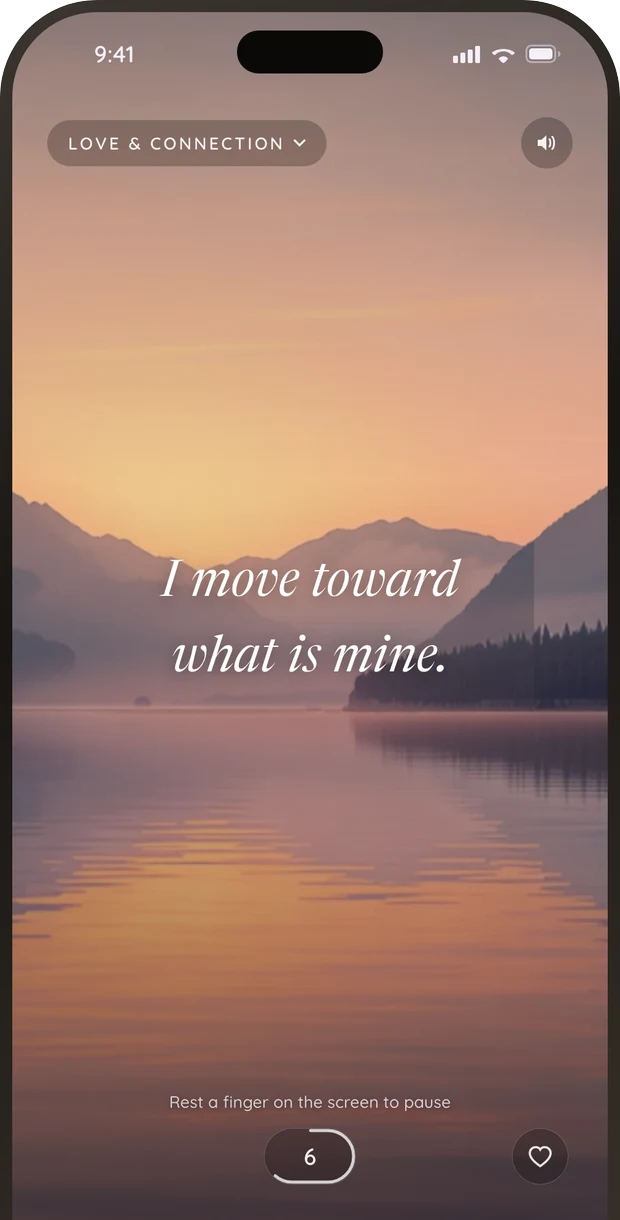
Shyne’s Affirm tab is full-screen affirmations over photography, narrated by four voices — Sophia, James, Clara and Daniel — with a play-all loop for when you’d rather listen than read. Write your own and yours lead the feed. Share any one as an image.
Today’s affirmation sits on your home screen as a widget, next to your intention and your practice ledger.
There are no streaks. A missed day is an empty square and nothing else. Your own affirmations, your journal and your voice recordings stay on your iPhone — not on a server, not in a training set.
Still curious
Questions people actually ask
What are positive affirmations?
Short, present-tense statements you say about yourself on purpose and repeat regularly — “I am steady under pressure,” “I do good work and I let it be seen.” The repetition is the mechanism. They're also called self-affirmations or I-am statements.
Do affirmations really work?
Sometimes, with an important caveat. Self-affirmation research supports the idea that reflecting on your values makes you less defensive and better able to cope under threat. But a well-known 2009 study found that people with low self-esteem felt worse after repeating statements like “I am a lovable person” — because a statement too far from what you believe triggers your own counter-argument. Affirm something you can almost believe, and it works far better than something grand.
How many times a day should I say affirmations?
Three to ten is plenty, at a consistent time. Frequency matters less than not skipping. If you want structure, the 369 method gives you three in the morning, six at midday, nine at night.
How long before affirmations start working?
Give it thirty days before judging. That's roughly how long it takes to stop hearing your own sentence as a sentence.
Should I say affirmations out loud or in my head?
Out loud, if you can. Speaking is harder to do absent-mindedly than reading, and hearing your own voice say it is measurably more persuasive than reading your own handwriting.
Are affirmations better in the morning or at night?
Morning sets the frame the day is read through; night lands when the mind is least defended. Both work. Pick the one you'll actually do.
Can affirmations be harmful?
They can backfire if the statement is far from what you currently believe — you end up rehearsing the counter-argument instead. They can also become avoidance if used to paper over something that needs addressing. Neither is a reason not to practise; both are reasons to write realistic affirmations and to get proper support when something is genuinely wrong.
Are affirmations the same as CBT?
No. CBT examines a belief and tests it against evidence. An affirmation asserts one. They're different tools, and for clinical difficulty, CBT with a qualified therapist is the appropriate one.
Are affirmations biblical?
It depends on what the affirmation is doing. Believers who use them generally distinguish declaring something they already hold to be true from attempting to cause an outcome through repetition — which is why scripture-based affirmations are so widely searched. Others in the same traditions object to the practice regardless. It's a real disagreement and worth asking someone in your own tradition rather than an app.
What's the difference between affirmations and manifestation?
An affirmation is a statement about who you are. Manifestation is a broader practice built around an intention about what you're calling in. The affirmation supports the intention by making it plausible to you.
What's the difference between affirmations and words of affirmation?
Confusingly, they're different things. “Words of affirmation” usually refers to one of the five love languages — verbal appreciation you give another person. Affirmations in the sense on this page are statements you make about yourself, to yourself.
Do I need an app for affirmations?
No. A notes app and a consistent time will do it. What an app adds is the part people drop first — being reminded gently, hearing it in a voice, and having somewhere the practice accumulates. Shyne is one option; there are free ones, and a piece of paper works too.
Shyne is a journalling and reflection practice. It is not medical, psychological or financial advice, and it does not claim any outcome.